

What Fits Inside a Bag? Orla Kiely's Answer, Powered by Tangiblee
What fits inside a bag? See how Orla Kiely helps shoppers judge bag capacity with Tangiblee's What Fits Inside feature.

Orla Kiely uses Tangiblee's What Fits Inside feature to show shoppers exactly what everyday items — a phone, keys, a laptop, a gym kit — fit inside each bag. It extends an approach the brand already used by hand, now applied automatically across the full catalog.
Orla Kiely is a UK-based design house known for its bold, distinctive prints and a bag collection that changes shape and silhouette with every season. That variety is core to the brand's identity. But it also means shoppers face a recurring question on every product page: will this actually hold what I need to carry?
Before adding Tangiblee, Orla Kiely was already trying to answer that question by hand.
The Challenge
Orla Kiely has long invested in giving customers as much information as possible about each bag — dimensions, detailed photography, and descriptive copy. But with such a wide range of shapes and silhouettes across the catalog, the team found that product dimensions alone were not enough to help a shopper picture what a bag could actually hold.
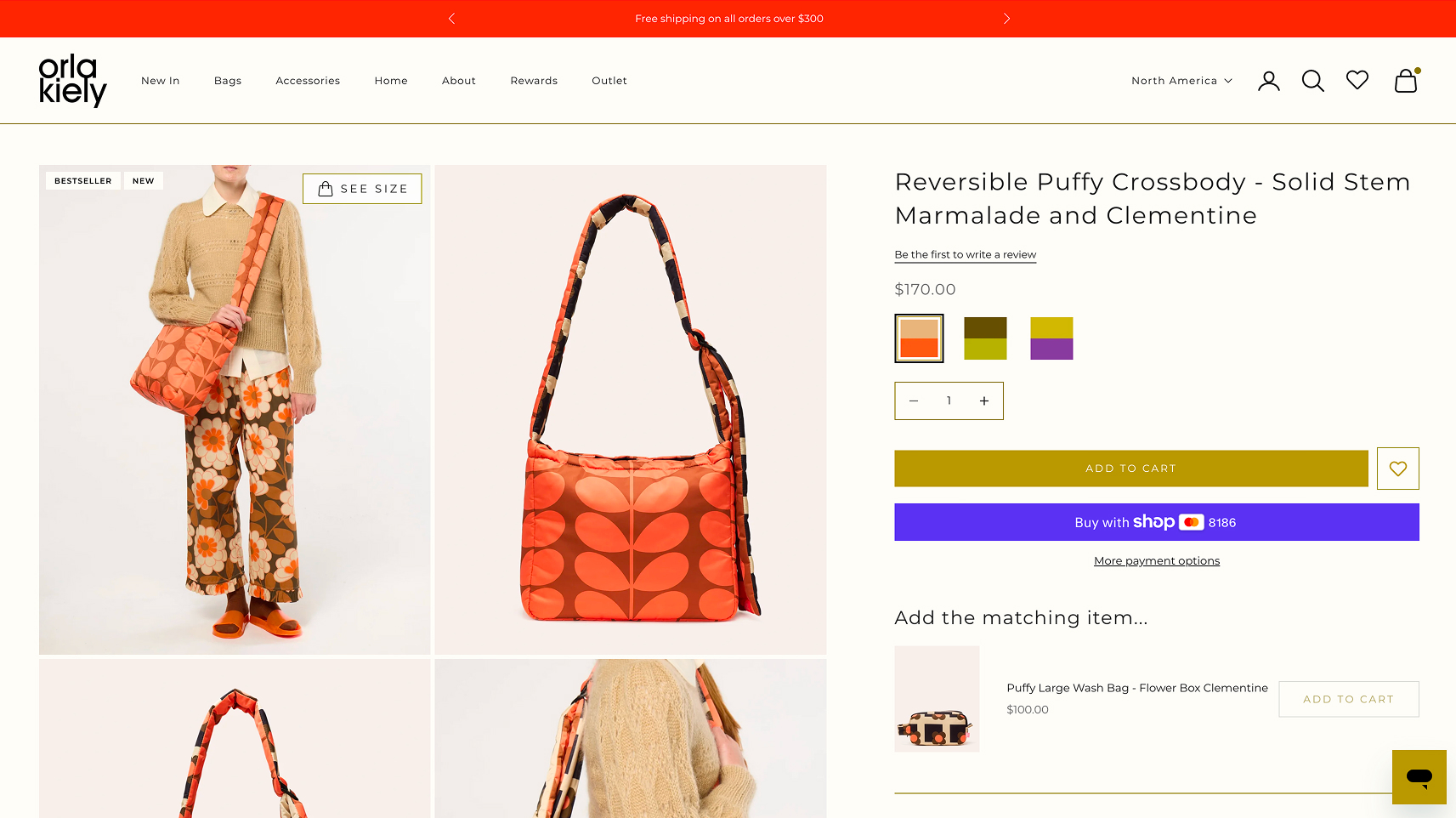
"We've always tried to give customers as much information as possible about the size and functionality of our bags — and with a new shape or silhouette every season, we wanted that information to be as accessible as possible."
— Becky Davies, Email and E-commerce Coordinator, Orla Kiely
The Manual Workaround
This gap led the team to a workaround well before Tangiblee entered the picture: hand-staging "what fits inside" photography, packing bags with everyday items to give shoppers a visual sense of scale.
It was a sign of how much this one detail mattered. Most product information can be resolved through imagery alone — but capacity was the detail most likely to leave a shopper hesitating rather than buying.
"People can see a bag and understand its design pretty quickly, but understanding whether it will fit their phone, keys, or laptop is a different question — one that photography doesn't always answer. We felt that was a gap Tangiblee could fill."
— Becky Davies, Email and E-commerce Coordinator, Orla Kiely
A Different Kind of Problem
Orla Kiely is, first and foremost, a design-led purchase — customers come to the brand for its prints and its color story. That makes capacity a distinct kind of problem to solve. A shopper who is already captivated by the design still hesitates over practicality — a tension common across handbag ecommerce (The 5 Biggest Pain Points of Buying Handbags Online and What You Can Do About Them) — and answering it well means doing so without disrupting the design-forward feel of the site.
How Tangiblee Solves It
Orla Kiely already organizes its site around the details shoppers care about most — Explore Prints and Shop by Material both let customers browse the catalog by the attribute driving their decision.
What Fits Inside extends that same logic to a third attribute: capacity, giving shoppers a way to understand a bag by what it can hold, not only by how it looks or what it is made of.
Rather than replacing the hand-staged photography the team had already built, Tangiblee's What Fits Inside feature scales that same instinct — pairing everyday items with each bag automatically, using the product images Orla Kiely already has on file. It works across the full range of prints and silhouettes, without requiring a new photoshoot for every release.
"Tangiblee felt like the simplest way for customers to be able to visualize the size and capacity of the bag before they make their decision."
— Becky Davies, Email and E-commerce Coordinator, Orla Kiely
Why It Matters
Orla Kiely's catalog was never short on information — dimensions, photography, and copy were all there. What was missing was a way to translate that information into something a shopper could picture instantly, without doing the mental math themselves.
By extending a method the team already trusted enough to do by hand, What Fits Inside closes that gap without asking Orla Kiely to change how it presents its collection — only how easily shoppers can answer one specific question before they buy.
Frequently Asked Qustions
Pourquoi la capacité d'un sac est-elle plus difficile à communiquer que les autres détails du produit ?
Les clients peuvent généralement juger du design et de la matière d'un sac à partir de simples photos, mais sa capacité dépend de son échelle, une notion difficile à transmettre par des images statiques ou de simples dimensions.
À quoi sert la fonctionnalité « What Fits Inside » de Tangiblee ?
Il montre aux acheteurs quels objets du quotidien, comme un téléphone, un ordinateur portable ou une tenue de sport, tiennent dans un sac spécifique, en utilisant les photos existantes du produit plutôt que de nécessiter une nouvelle séance photo.
Bring Your Catalog to Life
Experience the power of interactive product content.