
ChatGPT Try-On vs. True-to-Product: What Retailers Actually Need to Know
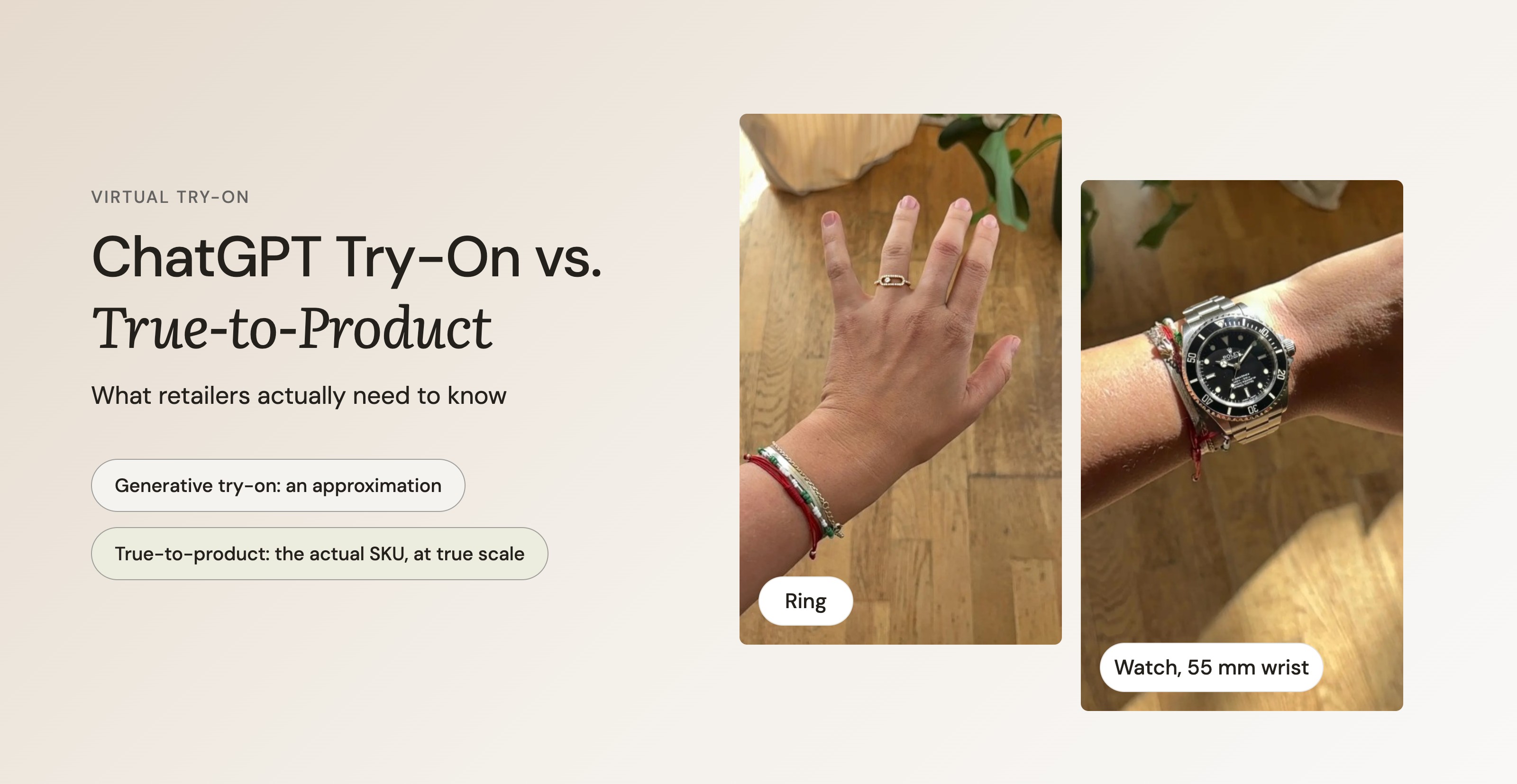
On October 1, 2026, OpenAI added a "Try On" option to ChatGPT shopping. A few months before that, Google rolled out AI-powered virtual try-on across Search and Shopping. Both are free, global, and available to any shopper with a phone.
This is not a threat to brands that already invest in virtual try-on on their own sites. It is a market signal.
Millions of shoppers are now learning a new behavior — uploading a photo, seeing how a product might look on them — inside platforms they already use every day. The expectation is being set at scale. For free. By the two largest consumer-facing AI platforms in the world.
But there is a significant difference between what these platforms offer and what a retailer actually needs. The difference is not whether generative AI try-on works. In some categories, it works surprisingly well. The difference is what gets rendered, where it happens, who controls it, and who benefits.
How ChatGPT and Google Try-On Actually Work
Both platforms use generative AI to create a try-on image. The shopper uploads a selfie or a full-body photo. The AI model generates a new image showing the product on the shopper's body — or, in the case of watches, on their wrist.
The key word is generates. These platforms do not pull the retailer's actual product image and render it at true scale. They use an image-generation model to create an approximation of the product based on what the model knows about it. ChatGPT uses its own image model (currently Images 2.5). Google uses Gemini alongside its Shopping Graph.
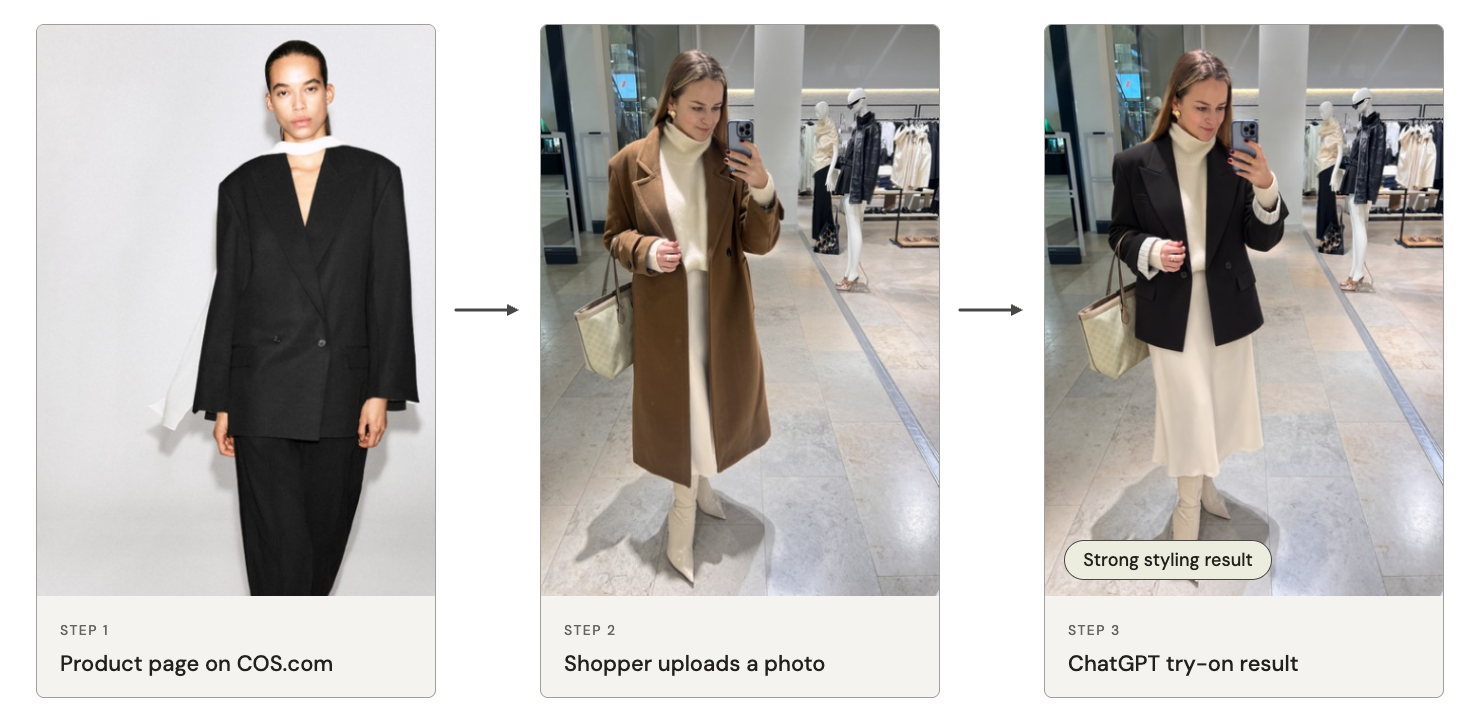
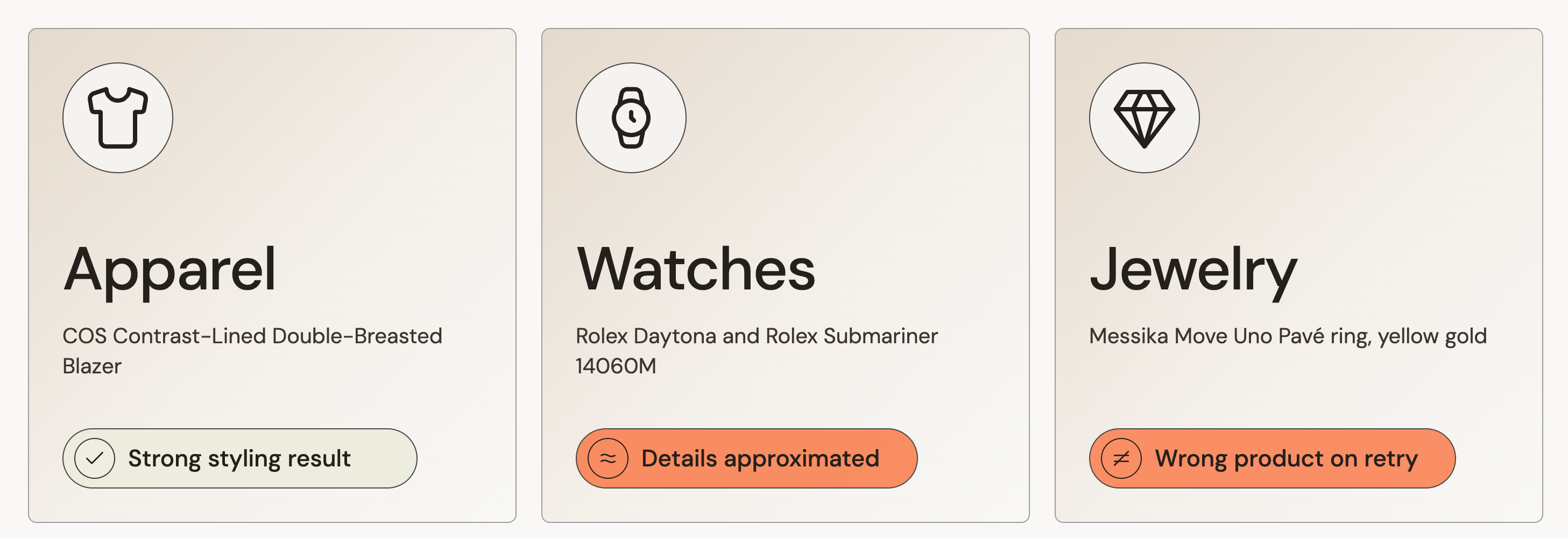
For clothing, the results are genuinely impressive. We tested the COS Contrast-Lined Double-Breasted Blazer — uploaded a mirror selfie in a brown coat and asked ChatGPT to swap in the blazer. It nailed the styling: right silhouette, double-breasted closure, structured shoulders, everything else in the scene untouched. You could immediately see how the blazer works with the rest of your outfit.
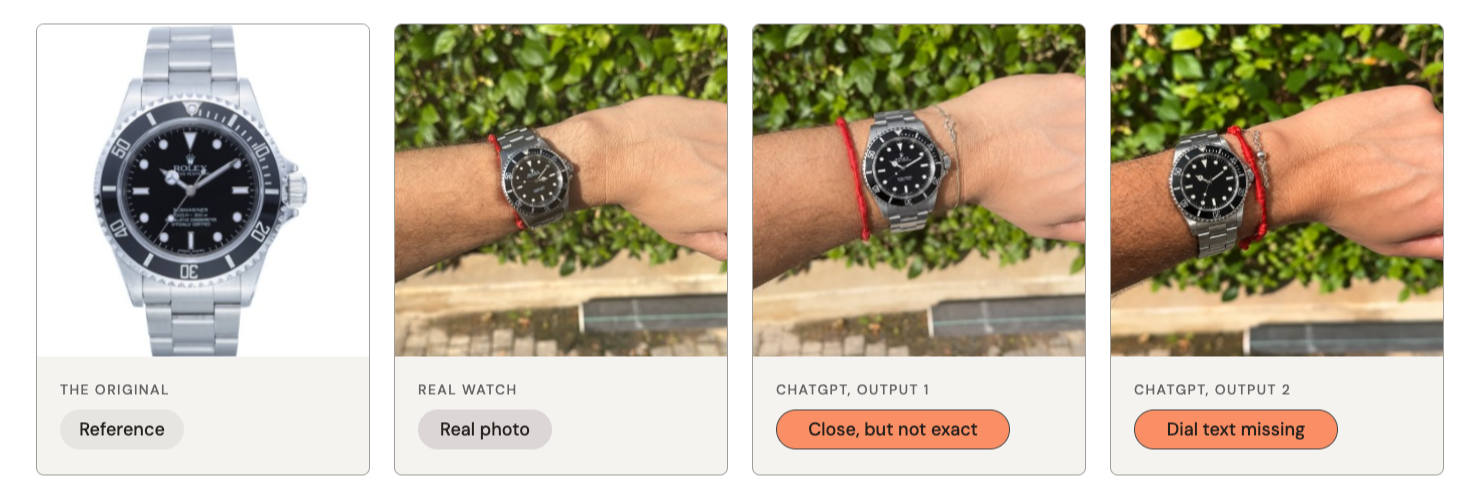
For watches, the picture changes. We tested two models — a Rolex Daytona and a Rolex Submariner 14060M. The first Daytona attempt failed entirely; the second took 53 seconds. The Submariner rendered, but with the same core problem: ChatGPT struggles to maintain the details that define a watch. Subdial proportions, bezel thickness, crown sizing, bracelet link geometry, color accuracy — the elements that distinguish a $15,000 reference from a lookalike were approximated, not reproduced. ChatGPT’s own verdict on its output: good for judging overall aesthetic, not yet trustworthy for exact product appearance.
But there is a more fundamental problem than visual accuracy: wrist sizing. ChatGPT does not know the shopper’s wrist. Is it 50mm across or 65mm? That difference completely changes how a 40mm case sits — and the shopper has no way to tell whether the generated image reflects their actual proportions. ChatGPT says so itself: it opens every watch try-on with a disclaimer that the result is approximate. The shopper gets an image that looks plausible but has no way to know if it is truthful.
On-site watch visualization solves this differently. A calibration tool measures the shopper’s actual wrist, and the watch renders at true scale against it. The shopper is not guessing whether the proportions look right — they are seeing exactly how a 40mm case with a 47.5mm lug-to-lug will sit on their specific wrist. That is the difference between a styled photo and a sizing tool.
For jewelry, the stakes go even higher. We tested the Messika Move Uno Pavé diamond ring in yellow gold — a piece where a single misplaced pavé stone or a wrong band profile changes the entire product.
The first ChatGPT attempt was actually solid. The ring looked close to the original, the gold tone was reasonable, the general shape was right. But when we ran the same test again — this time sending ChatGPT the direct link to the exact Messika SKU — it hallucinated. The ring it generated was a different design entirely. Same brand, same prompt, wrong product. The kind of error a shopper would never notice and a retailer cannot afford.
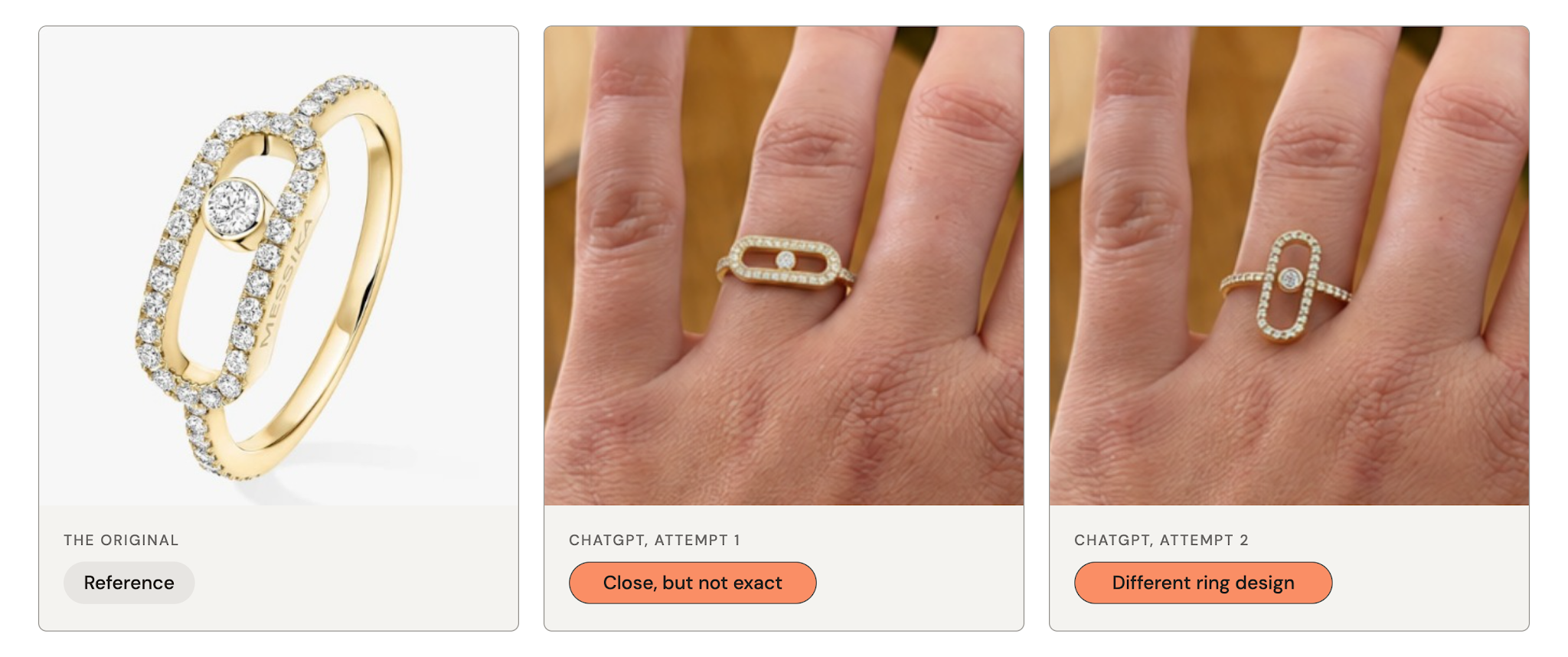
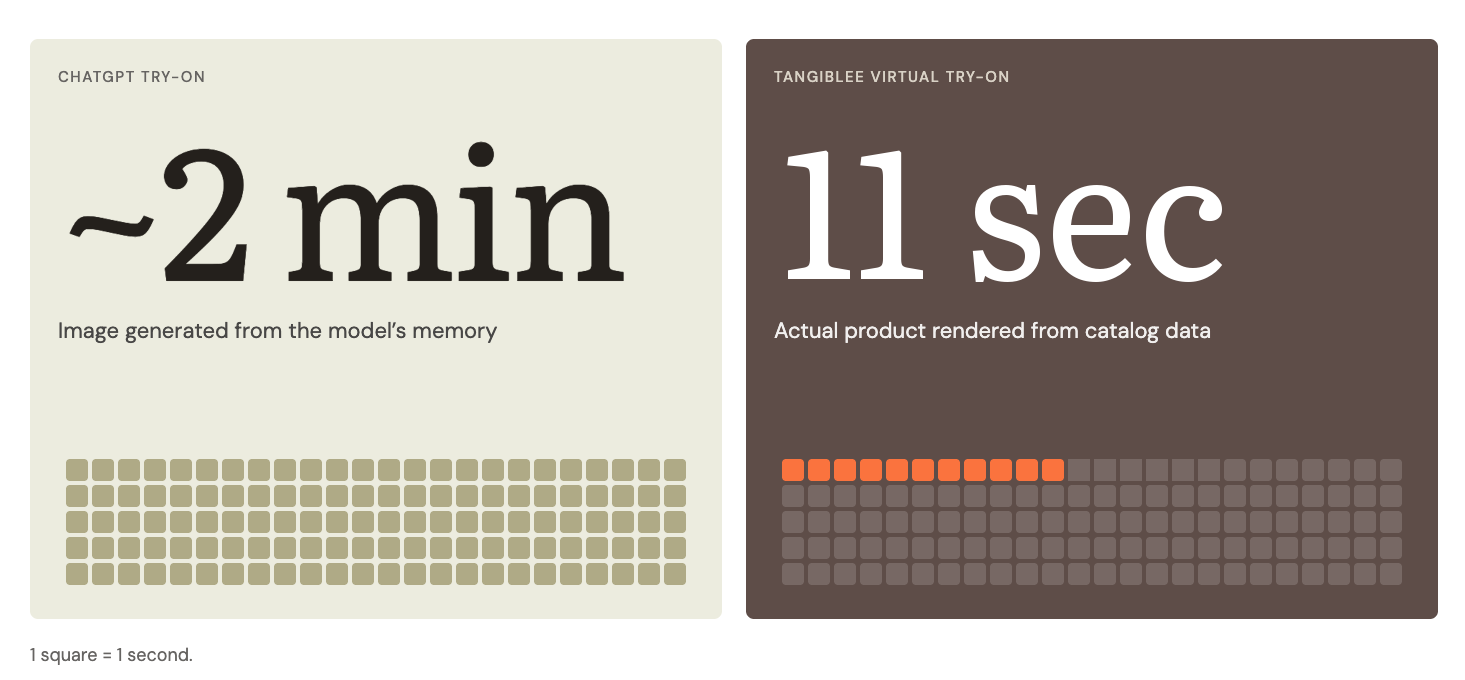
This is the core risk of generative try-on for jewelry. A blazer with a slightly simplified lapel is still recognizably that blazer. A watch with an oversized crown is still roughly that watch. But a ring with the wrong setting, the wrong stone arrangement, or the wrong band design is simply a different ring — and a shopper making a purchase decision based on that image is buying something they have not actually seen. The generation also took approximately two minutes.
Tangiblee Virtual Try-On owns the product, and creating a ring visualization for the same Messika SKU took 11 seconds — rendering the actual product from catalog data, placed on the shopper’s hand at true scale, with the design details intact because they were never generated from memory in the first place.
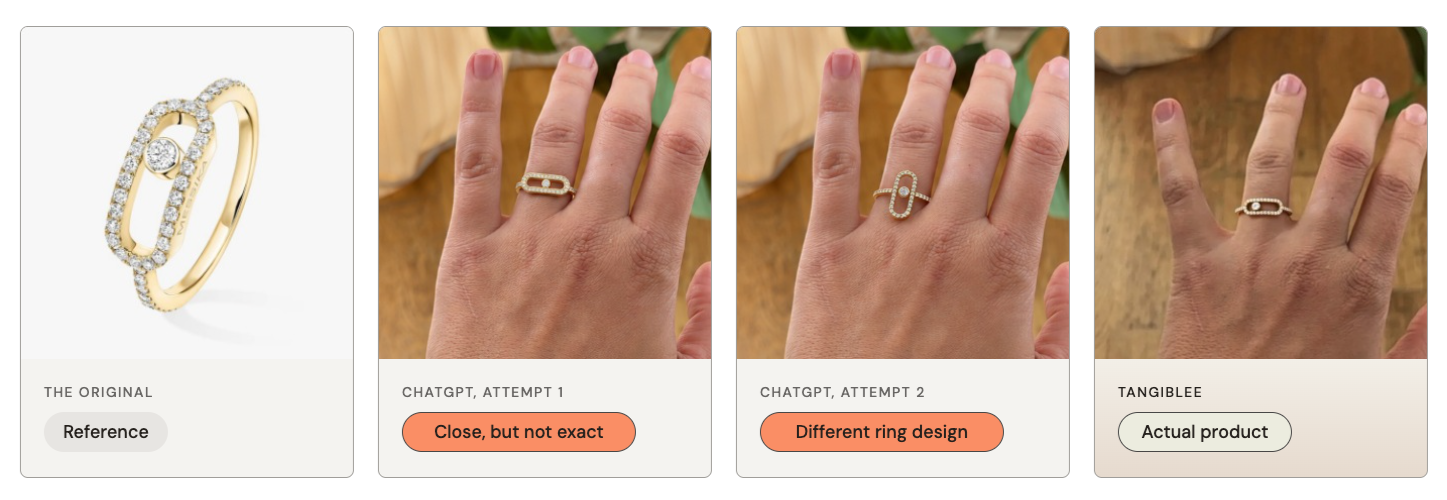
For a category where the difference between two SKUs can be a single row of stones, the question is not whether AI-generated try-on looks good enough. It is whether it shows the right product. And when the same prompt produces a different ring on the second attempt, the answer is: not reliably.
What Generative AI Try-On Gets Right
It would be dishonest to dismiss this technology. In some areas, it works almost perfectly.
The visual quality is improving rapidly. ChatGPT's clothing try-on output was convincing enough that a shopper could reasonably use it to evaluate whether a style or color works for them. Google's apparel results are similarly strong, and the company reports that 70% of U.S. users found virtual try-on made shopping more enjoyable.
The accessibility is genuinely new. Any shopper can now try on products — across brands, across retailers — from one interface, with no additional technology on the retailer's side. The barrier to try-on just dropped to zero for the end consumer.
And the market-education effect matters. Every shopper who uploads a photo to ChatGPT or Google and sees a product on themselves is one more shopper who will expect that experience on the retailer's own site. This normalizes virtual try-on as a standard shopping behavior, not a novelty feature.
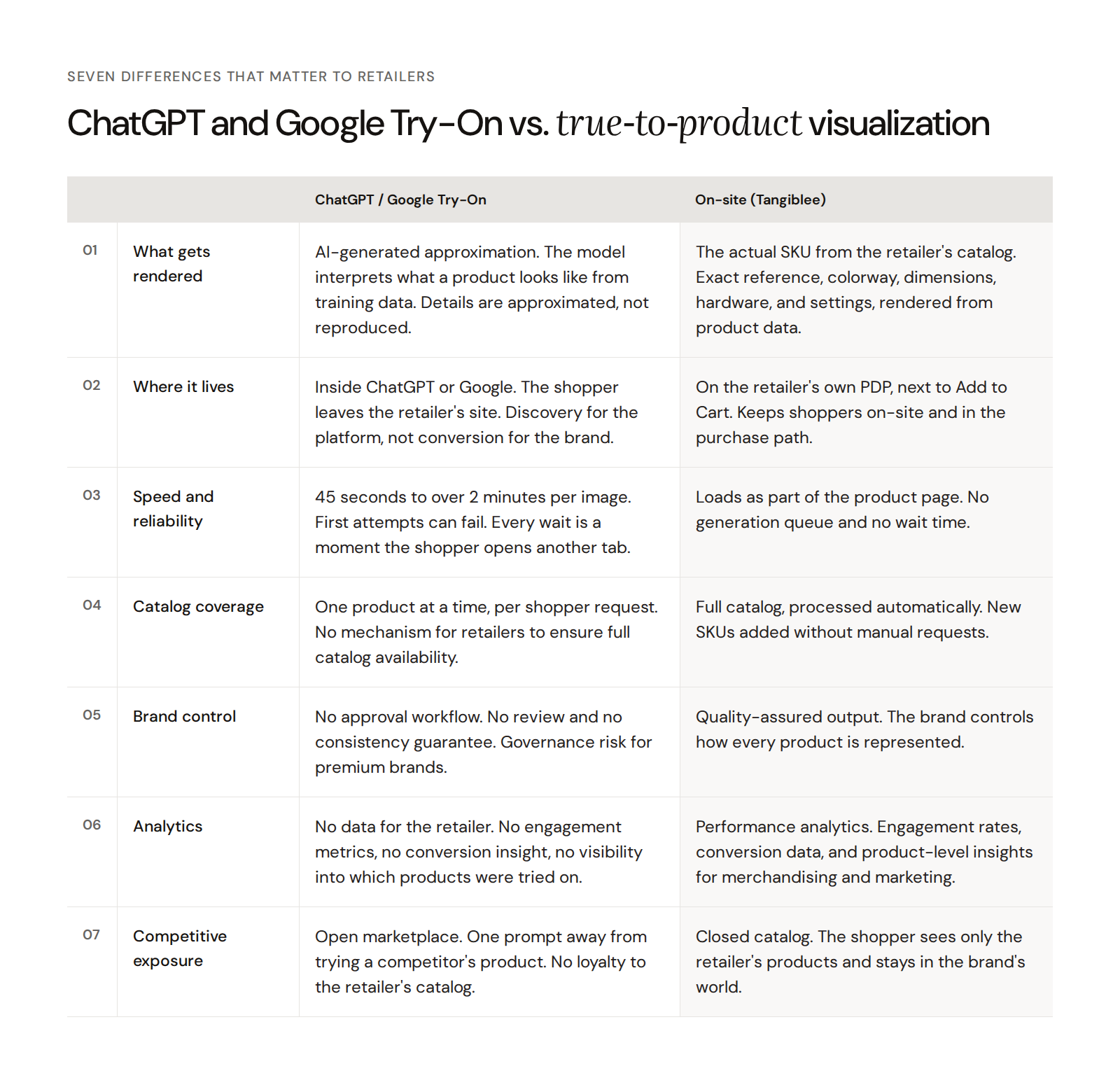
Seven Differences That Matter to Retailers
For the shopper browsing inside ChatGPT, generative try-on is a fun discovery tool. For the retailer responsible for product accuracy, brand control, and conversion, the gaps are structural.
1. What gets rendered: an approximation versus the actual SKU. Generative AI try-on creates an image that looks like the product. Tangiblee (On-site product visualization) renders the specific SKU from the retailer's catalog — the exact reference number, colorway, hardware, stone setting, and dimensions. For watches, this means the correct dial, bezel profile, and bracelet geometry. For jewelry, it means accurate carat sizing, prong detail, and metal tone. For bags, it means the right size, hardware finish, stitching pattern, and interior configuration.
2. Where the experience lives: on a platform versus on the PDP. ChatGPT try-on happens inside ChatGPT. Google try-on happens inside Google. On-site visualization appears on the retailer's product page, next to the Add to Cart button, within the brand's design language. A try-on that lives on a platform is product discovery for the platform. A try-on that lives on the PDP is conversion infrastructure for the brand.
3. Speed and reliability: seconds of generation versus instant rendering. In testing, ChatGPT took 53 seconds per ring image and a lot more for apparel. On-site visualization loads as part of the page — instantly, every time, with no generation queue. Every second a shopper waits on a high-consideration product is a moment they might open another tab, check another brand, or leave entirely.
4. Catalog coverage: one product at a time versus the full catalog. ChatGPT handles individual try-on requests. The shopper asks, the model generates, one product at a time. On-site visualization processes new SKUs automatically across the retailer's entire catalog, ensuring that every product a shopper lands on has the experience available without individual requests.
5. Brand control and approval: uncontrolled AI output versus QA'd rendering. When ChatGPT generates a try-on image of a luxury watch, no one at the brand reviewed it. No one approved the dial rendering, the bezel proportions, or the way the bracelet sits on the wrist. On-site visualization goes through a quality-assurance process. For luxury and premium brands, uncontrolled product representations carry real brand risk — especially at the detail level where these products compete.
6. Analytics and measurement: invisible interaction versus conversion data. When a shopper tries on a product inside ChatGPT, the retailer gets no data. No engagement metrics, no conversion correlation, no insight into which products were tried on or what happened afterward. On-site visualization provides the retailer with performance analytics — engagement rates, interaction-to-conversion data, product-level insights — that inform merchandising, marketing, and assortment decisions.
7. Competitive exposure: open marketplace versus closed catalog. For now inside ChatGPT or Google, a shopper who tries on one watch is one prompt away from trying on a competing watch from a different brand. The platform has no loyalty to the retailer's catalog. On the retailer's own PDP, the shopper sees only that retailer's products — the experience keeps them in the brand's world, not an AI model's marketplace.
The Question Underneath All of This
The real question is not "Is ChatGPT try-on accurate?" — for some products, it already is.
The real question is: who owns the experience, and where will the purchase be completed?
When try-on happens inside ChatGPT, OpenAI owns the interaction. They control the product representation, the surrounding recommendations, the next prompt. The shopper is in OpenAI's environment, not the retailer's. The same applies to Google.
When try-on happens on the product page, the brand owns it. The product rendering is accurate to the SKU. The experience sits next to the price, the reviews, the Add to Cart button. The brand controls what the shopper sees, how the product is represented, and what happens next.
This is not a new dynamic. It is the same one that has played out with every platform feature that overlaps with retailer capabilities — from Google Shopping to Instagram checkout to marketplace search. The platform builds reach. The brand builds conversion. The question is always: where does the shopper make the decision, and who set the terms?
What This Means for Brands
ChatGPT and Google are doing something useful for retailers: they are teaching shoppers to expect virtual try-on. They are normalizing the behavior at a scale no individual brand could achieve alone.
But the expectation they set is not one they can fulfill for the retailer. A shopper who tries on a ring inside ChatGPT and then lands on a jeweler's product page will expect the same capability — but with the accuracy, speed, and brand control that a purchase decision requires.
The brands that already have true-to-product visualization on their sites are positioned to capture that expectation. The brands that do not will find that the gap between what shoppers now expect and what their PDP delivers has widened — thanks to the very platforms that created the expectation.
Generative AI try-on and on-site product visualization like Tangiblee are not the same category. One is discovery. The other is conversion. One shows shoppers what a product might look like. The other shows them exactly what they are buying.
They Own the Verb. We Own the Product.
ChatGPT and Google taught the world to try on. That is a gift to every brand that already offers the real thing.
Because "try-on" is now a behavior, not a feature. And when shoppers bring that behavior to your product page, the question is simple: are they seeing a guess from an AI model, or the actual product they are about to buy?