
Lucardi Jeweler first in the Netherlands to offer Virtual Try-On, with tech partner Tangiblee
Chicago, IL - January 6, 2022
This story references an article originally published on Retail Dive.
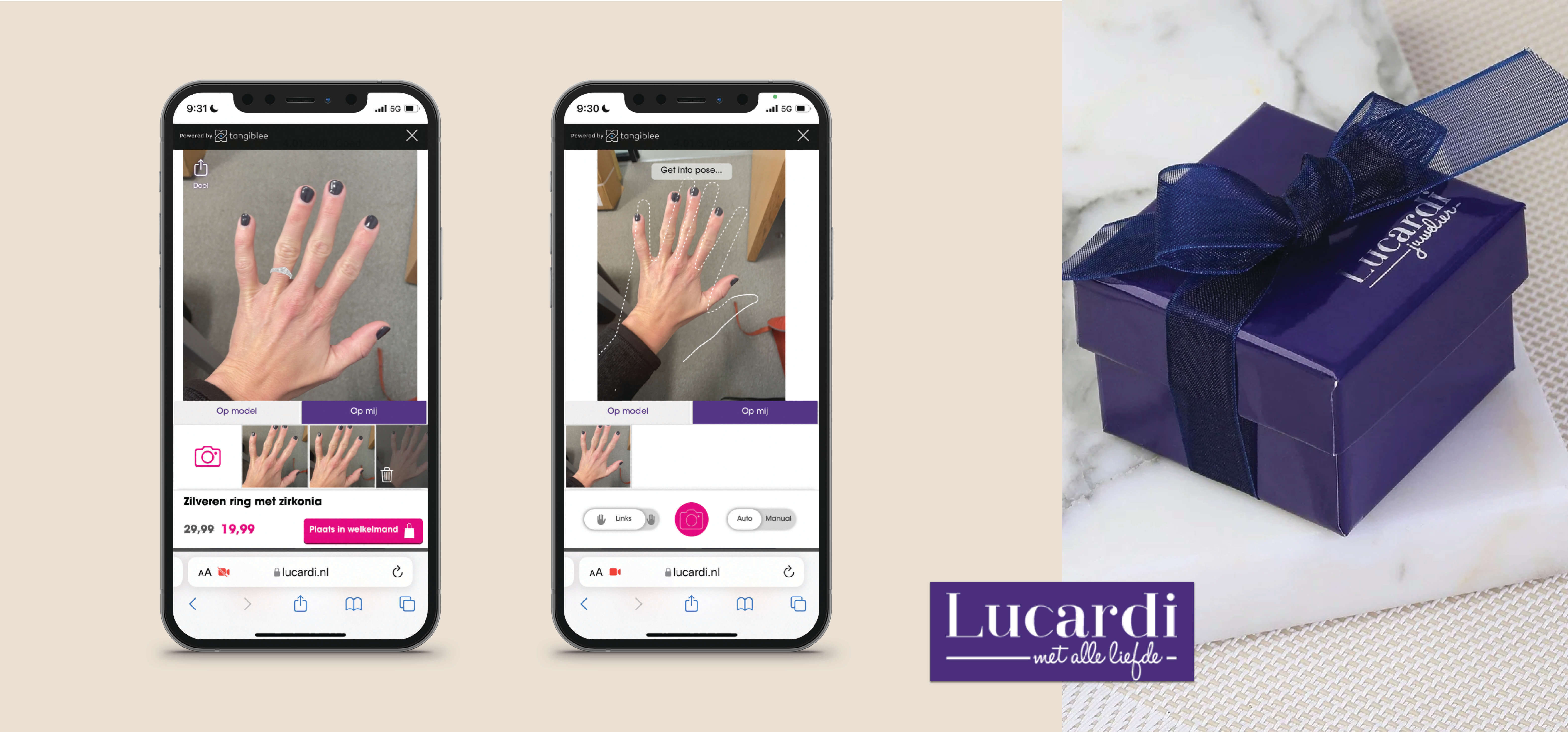
The Netherlands’ largest jewelry chain, Lucardi Jeweler is bringing a new customer experience to its online store. The Dutch jewelry leader is implementing a markerless, web-based augmented reality feature, Virtual Try-On, with the help of e-Commerce technology partner, Tangiblee. The Virtual Try-On experience allows Lucardi customers to interact with jewelry item and see how it’s worn on a model image or even on their own hand (AR). The solution requires no app or any additional assets from Lucardi, Tangiblee generates an on-page interactive experience that allows shoppers to play and see jewelry pieces on a series of lifestyle models or “try-on” virtually on their own hand or ear.
"We're very excited about our partnership with Tangiblee. We see this as an important first step that allows us to provide our customers with interactive functionality that empowers them to make informed decisions when it comes to jewelry, accessories, and other fashion trends,” said Elles van Leeuwen, Omnichannel Development Manager at Lucardi.
Lucardi is rolling out the interactive solution across all jewelry categories including rings, bracelets, earrings, pendant necklaces, and watches. What makes Tangiblee’s solution truly unique is the ability to produce this experience by leveraging the existing 2D product imagery from Lucardi’s digital catalog.
“The Virtual Try-On feature is great. The onboarding process with Tangiblee was simple and we’re very pleased with the initial results from the built-in reporting and A/B testing. We are really impressed by how scalable Tangiblee is. We managed to cover thousands of products quickly,” said van Leeuwen.
The Tangiblee solution will help Lucardi drive more sales, increase revenue per visitor, and increase customer confidence. The Lucardi implementation of Tangiblee will be introduced across three regions, including the Netherlands, Belgium, and Germany, and will serve upwards of 10,000 jewelry SKUs. Lucardi is also excited to leverage Tangiblee’s management reporting dashboard (Tangiblee Management Portal) to gather insights in order to further optimize the experience and measure the solution’s impact to its bottom line.
ABOUT LUCARDI: Lucardi Jeweler is the largest jewelry store in the Netherlands and has been voted as the Best Chain Store and Best Webshop in the Fashion Accessories category from 2020-21.
About
Tangiblee is an eCommerce product experience platform that delivers interactive customer experiences to every product page - providing value to a retail customer and the retailer. Tangiblee extracts existing product imagery & details from the product page and re-packages the content into an interactive on-page experience - at scale. The UX is custom-built for every retailer and supplies brand-curated content to every product UX. Compatible with any retail platform – app or web-based - Tangiblee can serve product catalog sizes of one hundred SKUs to hundreds of thousands of SKUs. Tangiblee helps retailer partners provide the best possible digital shopping experience for customers without needing the overhead of a technical team to integrate or maintain. Tangiblee has rolled out a Virtual Try-On feature for all jewelry categories including luxury watches.