
What Does Artificial Intelligence Mean for E-Commerce?
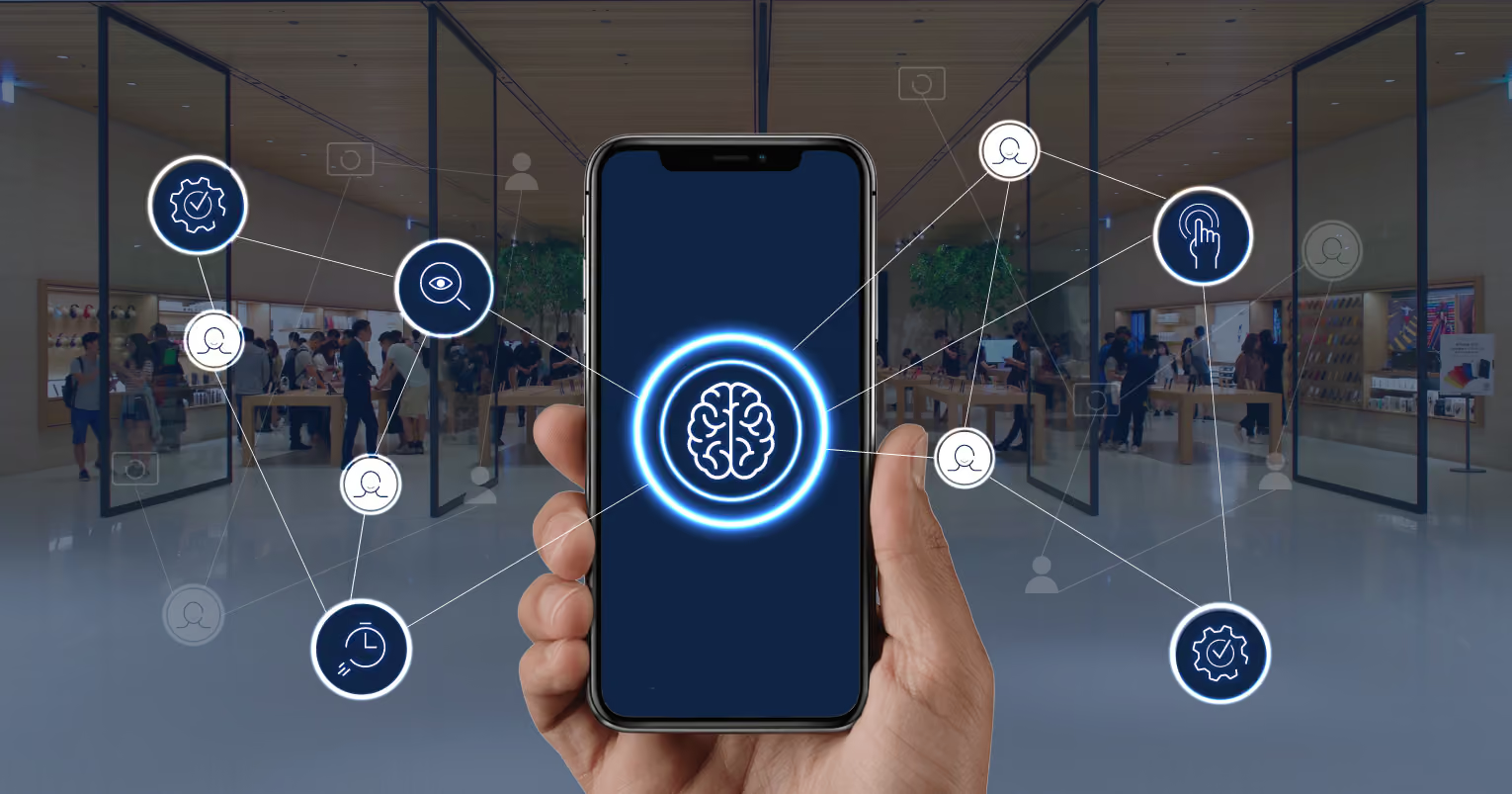
Artificial intelligence has significantly evolved over the past several years — with digital retail arguably experiencing the most noticeable improvements.
Through AI, retailers can provide a better customer experience, more accurately targeted marketing, and enhanced customer support. More importantly, they can make smarter, more data-driven decisions, optimizing everything about their stores.
In short, artificial intelligence has fundamentally changed the face of retail, and will continue to do so for the foreseeable future. For e-commerce retailers especially, it's a true game-changer.
Before we can discuss that, however, we must first discuss what artificial intelligence is not.
All Aboard the Hype Train
Hype is a funny thing. To hear some people talk, ChatGPT is the most revolutionary piece of technology since the invention of the Internet. While the chatbot is certainly sophisticated, it's not the massive leap forward in artificial intelligence that many seem to believe.
For one, it's not technically artificial intelligence. According to Oxford University Professor of Computer Science Dr. Michael Woolridge, it's actually something known as a large language model. It's capable of convincingly mimicking human communication and performing largely superficial reasoning and problem-solving, but that's about it.
ChatGPT doesn't understand the context of what it says. It isn't capable of creativity, nor can it offer genuine depth or insight in its responses. It also has a nasty tendency to report inaccurate facts or simply make things up, a phenomenon referred to as hallucinating.
That isn't to say that tools like ChatGPT are unimpressive or lack value for e-commerce. They're simply overhyped at the moment, and the current fervor around them demonstrates a fundamental misunderstanding of artificial intelligence. There's also the issue of how ChatGPT's language model was trained — by scraping hundreds of gigabytes of text off the Internet, something which has landed developer OpenAI in legal trouble.
ChatGPT isn't particularly unique in its problems, either. It represents a problem that's grown increasingly common in the AI industry. Namely, it's been adopted and talked up endlessly by people who don't actually understand the technology.
The fact remains that while AI is very good at what it does and has enormous potential, there are certain things it simply cannot do:
- Empathize and understand emotion.
- Brainstorm novel ideas without relying on training data.
- Engage in genuine conversation.
- Practice intuition.
- Understand abstract concepts.
It's important to emphasize that these shortcomings in no way limit the value or potential of AI. Rather, they simply ensure that the technology is at its best when paired with human intelligence. For those who understand this fact and employ AI with full knowledge of its limitations, it remains an immensely valuable tool.
With this in mind, it should come as little surprise that the global AI market is expected to reach nearly two trillion dollars in value by 2030 — nor that retail is among the chief industries driving this growth.
Unlocking a Smarter Retail Landscape
Already, retailers leverage artificial intelligence in a variety of different ways:
- Creating better customer profiles through a combination of machine learning, analytics, and natural language processing. In addition to greatly improving personalization throughout the buyer's journey, this also helps retailers more effectively target their advertising and marketing efforts.
- Leveraging technology like ChatGPT's API to support broader product catalog searches.
- Providing 24/7 customer support through increasingly-sophisticated chatbots.
- Optimizing inventory management and streamlining operations through intelligent automation.
- Safeguarding against fraud and other cyber threats.
- More accurately forecasting demand, predicting customer behavior and identifying market trends.
- Automatically adjusting pricing based on market conditions.
- Supporting visual- and voice-based product searches.
- Tracking customer satisfaction and identifying potential shortfalls.
Yet even this comprehensive list of use cases barely scratches the surface of what AI can do for online retail. By combining automation, Internet-connected sensor technology, and AI-driven software, there's the potential to revolutionize the entire retail supply chain, from the factory floor to the customer's home. Retailers and customers alike stand to benefit from reduced overhead, faster and more reliable deliveries, and greatly improved logistics.
Tangiblee itself represents another use case. Our platform's powerful human-in-the-loop artificial intelligence allows it to generate compelling, photorealistic lifestyle imagery from simple product photos.
Looking Toward the Future: Where Does AI Fit Into E-Commerce?
So, what comes next for AI in the e-commerce sector?
First and foremost, the value of the retail AI industry is expected to reach nearly $46 billion by 2030. In that time, we expect to see more and more retailers embrace increasingly-refined AI-driven shopping experiences. And though it's impossible to truly predict impending industry disruptions, we expect that the lawsuit against OpenAI will be the first of many, as AI contends with arguably its greatest dragons yet — ethics and privacy.
Beyond that, the only other thing we can say is that it's in your best interest to adopt the technology sooner rather than later. The potential efficiency gains, cost reduction, and improvements to the customer experience together will provide a competitive advantage that's simply too significant to ignore.
To learn more about how Tangiblee is leveraging human-in-the-loop AI, schedule a demo today.