
Tangiblee Is Compliant with the EU AI Act and Ready for New York's AI Advertising Law
If you sell jewelry, watches or bags online, there is a good chance AI-generated imagery is already somewhere in your funnel: a model wearing the bracelet, a lifestyle shot of the watch, a campaign visual your agency generated last month. In 2026, two laws started asking a simple question about all of it: can anyone tell this was made by AI?
For brands using Tangiblee on-model imagery, the answer is yes, and it took no work on their side. Here is what changed, what we handle, and the one thing that stays with your brand.
What the EU AI Act means for AI-generated product images
The EU AI Act now requires every AI-generated or AI-edited image to carry an invisible, machine-readable marking, so that platforms and regulators can detect that it was produced by AI. That duty sits with the company providing the AI technology, not with the brand using it. New AI systems have had to comply since 2 August 2026; systems already in use have until 2 December 2026.
There is a second, separate duty for brands: if you show realistic AI imagery to shoppers, including in ads, you need to tell them it is AI-generated. The European Commission has confirmed this covers advertising.
What New York's synthetic performer law means for ecommerce ads
Since 9 June 2026, any advertisement reaching New York that features an AI-generated person has to say so clearly. The duty is on the advertiser. Fines start at 1,000 USD and rise to 5,000 USD per violation after that. Whether an AI-generated model in a product image counts as a "synthetic performer" is still an open question, which is exactly why a short disclosure is the sensible default.
How Tangiblee makes AI on-model imagery compliance-ready
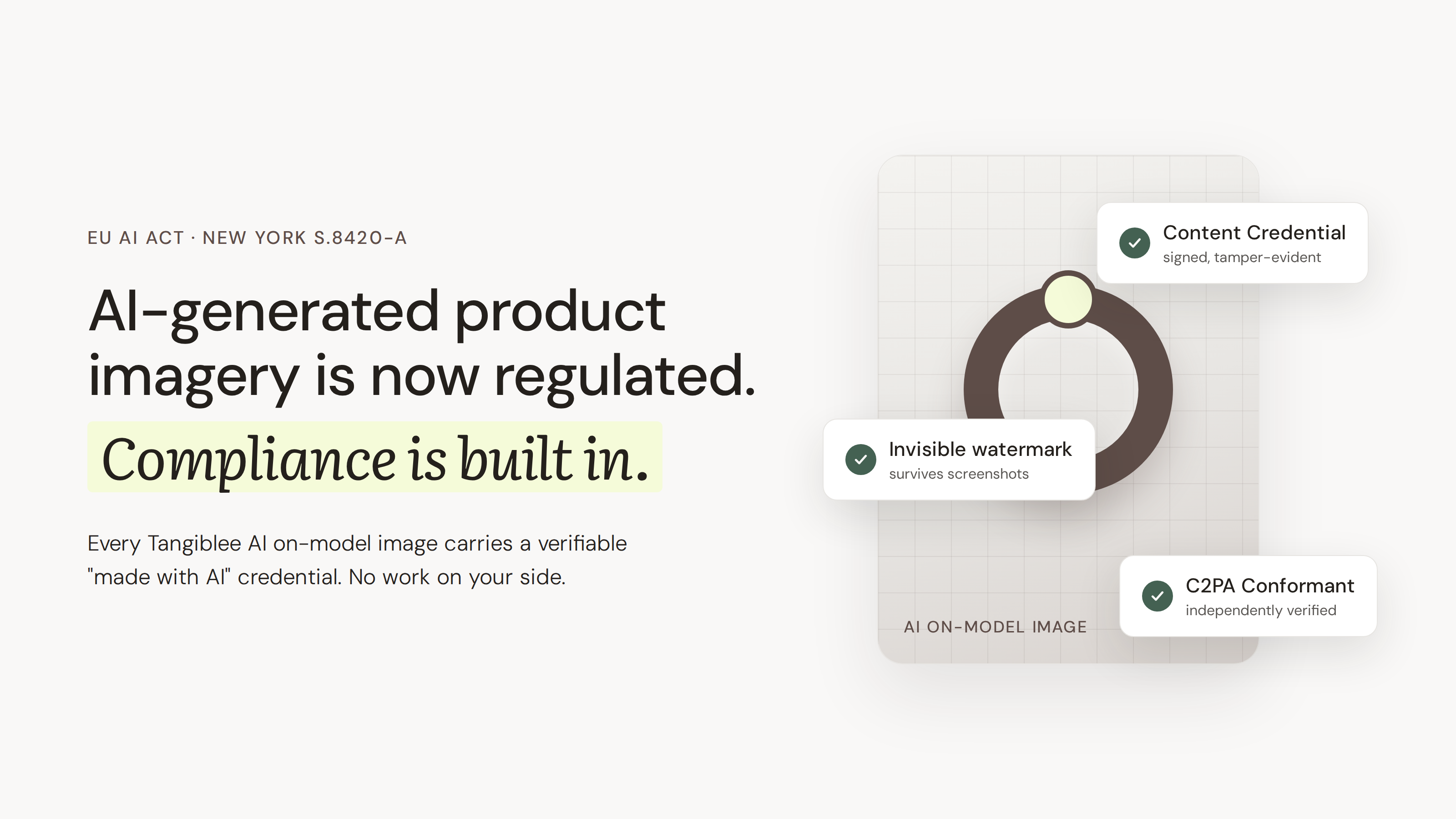
Every AI-generated on-model image Tangiblee produces now carries a machine-readable marker identifying it as AI-generated by Tangiblee. The marker has two parts: a C2PA Content Credential, the industry standard for tamper-evident "made with AI" labeling, and an invisible watermark embedded in the image itself that survives screenshots and re-uploads.
Shoppers never see it. Anyone who needs to check an image, such as a platform, a regulator or your own legal team, can verify it in seconds with a public tool like Content Credentials Verify. No Tangiblee account is needed.
The labeling is independently verified. Tangiblee AI has passed C2PA's conformance review and is listed on the public C2PA Conforming Products List (search for "Tangiblee AI"), alongside tools from other members of the standard. That means our "made with AI" marking is not a self-declaration. It is checked by a third party and published for anyone to see.
Nothing is asked of your team: no metadata work, no watermarking software, no change to how imagery reaches your product pages.
Built in versus do it yourself
This is where the choice of imagery source starts to matter commercially.
If your team generates on-model or campaign visuals with a general-purpose AI tool, the compliance stack becomes your project: marking, watermarking, a way for third parties to verify, and keeping all of it current as the rules move. With Tangiblee on-model imagery, that work is done once, on our side, for every SKU, including new ones as they arrive.
What stays with your brand is one decision, not a project: how you tell shoppers an image is AI-generated where the law requires it. In the EU, that is a short label on realistic AI imagery shown to consumers. In New York, it is a clear disclosure on ads with AI-generated people. Agree the wording once with your legal counsel, apply it consistently, and the verifiable credential on every Tangiblee on-model image backs it up.
Why this matters now
AI imagery is becoming standard in jewelry, watch and bag ecommerce for a good reason: it lets shoppers see the product on a person, at the right scale, before they buy. The regulation does not change that. It changes the cost of getting the paperwork wrong. Choosing imagery that arrives compliance-ready, and verifiably so, takes that cost off the table.
Want to see how this fits your current setup? Talk to your Tangiblee account manager or request a walkthrough.
This article is for general information and does not constitute legal advice. Brands should confirm their obligations with legal counsel.