
The Most Realistic Virtual Try-On for Watches

Tangiblee’s High Fidelity Virtual Try-On is designed to make watch VTO realistic, correctly sized and easy to scale across a catalog. It uses existing PDP product images, calibrates the watch to the shopper’s wrist, adapts lighting and reflections to the photo, and does not require brands to provide 3D models.
That combination matters.
A watch can look realistic but still feel wrong if the size is off. It can be perfectly sized but look fake if the lighting does not match the shopper’s photo. And even a strong VTO experience becomes difficult to scale if every new SKU requires another 3D asset.
For watch virtual try-on to work, realism, sizing, calibration and scale all matter.
What makes Tangiblee’s watch VTO different?
Tangiblee’s High Fidelity VTO is built around four things:
Realistic product appearance
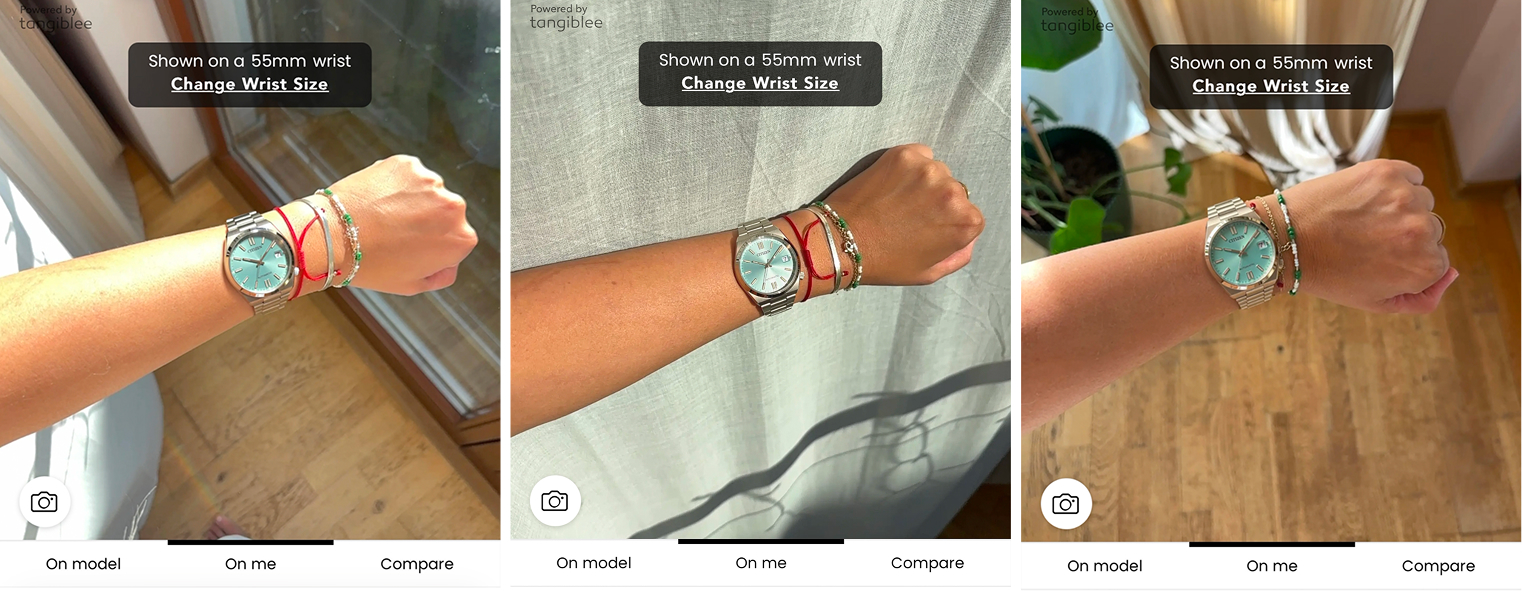
The watch adapts to the shopper’s photo, including lighting, shadows, reflections and angle.
Calibrated sizing
The watch appears in proportion to the shopper’s wrist instead of as a fixed overlay.
Product fidelity
The watch remains tied to the brand’s own product imagery, including dial color, finish and proportions.
Catalog scalability
Brands can use existing PDP images instead of creating a separate 3D model for every watch.
Why is sizing so important for watch virtual try-on?
A few millimeters can change how a watch looks on the wrist. The same 37 mm watch can look more substantial on a narrow wrist and more understated on a broader one. That is why Tangiblee calibrates the watch to the shopper’s wrist.
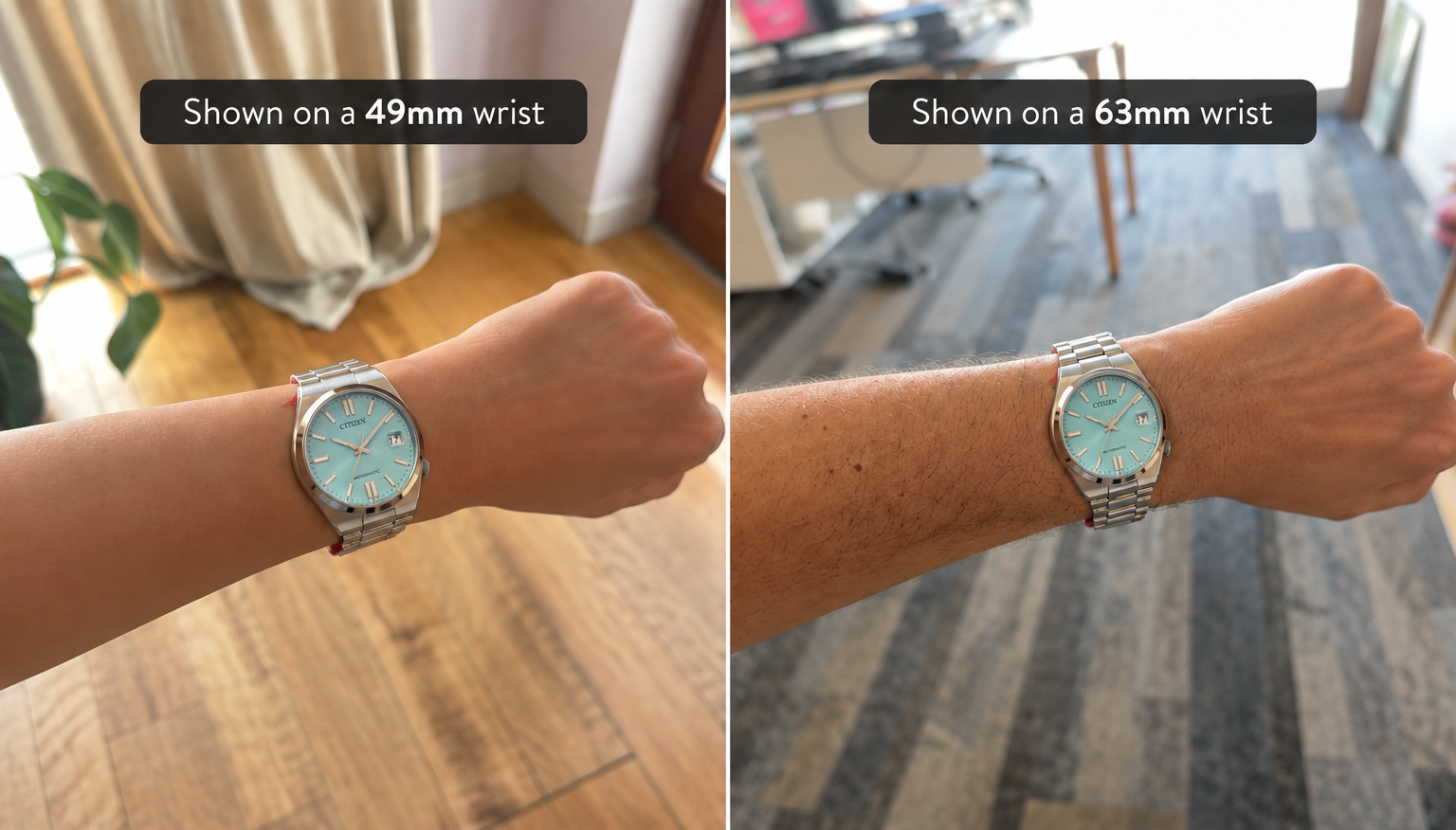
The watch is the same size in both images.The wrist is not. Virtual try-on turns a product measurement into something the shopper can judge visually.
What does calibration mean?
Calibration means showing the watch at the right scale and position relative to the shopper’s wrist. Tangiblee’s High Fidelity VTO uses product sizing and wrist context so the watch does not appear too large, too small or incorrectly positioned. For watches, this is part of realism.
Why does lighting matter?
Watches react strongly to their environment. A polished bezel catches highlights. Bracelet links move in and out of shadow. A dial can look slightly different depending on the light. Tangiblee’s High Fidelity VTO adapts the watch to the lighting, shadows, and reflections in the shopper’s own wrist photo. This helps the watch look like it belongs in the image, rather than sitting on top of it.
How does Tangiblee High Fidelity VTO work?
- Tangiblee uses the product images already on the PDP.
No dedicated VTO photoshoot is required. - The watch is calibrated using product sizing.
This helps place it correctly on the shopper’s wrist. - Each eligible SKU is processed and quality-checked.
- The shopper takes the wrist photo.
- The watch adapts to the photo.
Size, angle, lighting, shadows and reflections are adjusted to fit the wrist image. - The shopper can compare multiple watches on the same photo.
Why use one wrist photo instead of live AR?
Live AR can work well for a quick look. Tangiblee’s photo-based High Fidelity VTO is especially useful for comparison. The shopper captures the wrist once, then switches between watches on the same image.
That makes it easier to compare:
- different case sizes
- steel versus two-tone
- different dial colors
- bracelet versus strap
- multiple products side by side
There is no need to keep the phone pointed at the wrist throughout the session.
What does the brand need to provide?
Very little. Tangiblee High Fidelity VTO is designed to work from existing PDP imagery.
Brands do not need to provide:
- 3D models
- a dedicated VTO photoshoot
- separate try-on assets for every SKU
- prompts for individual outputs
- an internal approval workflow for every shopper image
Tangiblee manages the product-processing workflow. This makes watch VTO easier to scale across a growing catalog.
Why does this matter for large watch catalogs?
A VTO experience is only useful if the brand can maintain it. Creating and updating 3D assets for every reference can become difficult as new products and colorways launch. Tangiblee reduces that dependency by using existing product imagery. That makes it easier to expand VTO coverage as the assortment changes.
Does Tangiblee watch VTO affect sales?
In published Tangiblee programs, watch VTO has been associated with higher conversion and revenue.
These results come from specific client setups and should not be treated as guaranteed outcomes.
- Citizen (US): in a statistically significant A/B test, Tangiblee VTO and on-model imagery were associated with +15.7% revenue per visitor and +7.98% conversion rate. Citizen then launched on Citizen US and Bulova. Case study
- Movado: in a 50/50 A/B test of the Virtual Try-On button, conversion rate rose 7.82% and revenue per user rose 8.01%. Case study
- Casio Europe (Germany): from October 2025 to April 2026, the embedded VTO and Premium On-Model experience served more than 497,000 sessions. Shoppers who saw it converted 72.57% higher and generated 83.79% more revenue per session than those who did not. This compares exposed and unexposed users, so it shows association, not causation. Case study
- Watches of Switzerland Group: after an A/B test on Goldsmiths, Tangiblee VTO expanded to Watches of Switzerland and Mappin & Webb in the UK and Watches of Switzerland and Mayors in the US. Case study
Realism is only part of the test
The best watch virtual try-on needs to do more than look good.
It needs to:
- look like the real product
- appear at the right size
- adapt to the shopper’s wrist and environment
- and scale without creating a heavy production workflow for the brand
That is what Tangiblee’s High Fidelity Virtual Try-On is designed to do.
Realism. Sizing. Calibration. Scale.